Q9. Describe, with the aid of a sketch, the structural features of the bow forward bulkhead which impart structural strength to resist the stress imparted on the vessel. (16)
- - - Previously Asked - - -
Q9. Describe, with the aid of a sketch, the structural features of the bow which impart structural strength. (16)
Q9. Explain the meaning and purpose of EACH of the following ship terms:
(a) Keеl. (4)
(b) Beam. (structural member) (4)
(c) Girder. (4)
(d) Frame. (4)
Q9. With reference to forward collision bulkheads:
(a) Describe their construction (8)
(b) State their function (4)
(c) State their position, giving a reason for this positioning (4)
Q13. (a) state the advantages and disadvantages of aluminium alloy in ship building. (4)
(b) Describe, with the aid of sketch, a method of welding aluminium panels. (6)
Q12. With reference to the structure of a large passenger vessel:
(a) Describe how the spread of smoke and fire is prevented.
(b) Describe the standard fire test for a Class A-60 Division material.
Q13. (a) State FOUR reasons for transverse watertight bulkheads in ship construction. (4)
(b) State the minimum number of transverse watertight bulkheads and their location. (4)
(c) Describe how watertight bulkheads are tested. (2)
Q12. Describe EACH of the following, stating what component parts of the ship’s structure help resist the effect:
(a) Racking. (2)
(b) Panting. (2)
(c) Pounding. (2)
(d) Water pressure effect. (2)
(e) Drydocking stresses. (2)
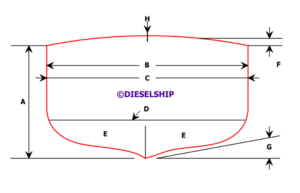
Q9. With reference to ships construction terminology, identify EACH of the areas annotated A-H in the diagram below: (16)
Q8. (a) Describe, with the aid of a sketch, a freeing-port. (8)
(b) Explain how freeing-ports assist in maintaining the stability of a ship. (8)
Q9. (a) Sketch and describe EACH of the following ship construction features:
(i) Plate floor (6)
(ii) Watertight bulkhead (6)
(b) Explain how watertight bulkhead integrity may be tested (4)
(a) Transverse watertight bulkhead (4)
(b) Bilge keel (4)
(c) Shear strake (4)
(d) Cofferdam (4)
(a) Hawse pipe. (4)
(b) Chain Stopper. (4)
(c) Fairlead. (4)
(d) Bollard. (4)
Username or email address *Required
Password *Required
Note: Entering wrong username in the login form will ban your IP address immediately. Entering wrong password multiple times will also ban your IP address temporarily.
Log in
Lost your password? Remember me
No account yet?